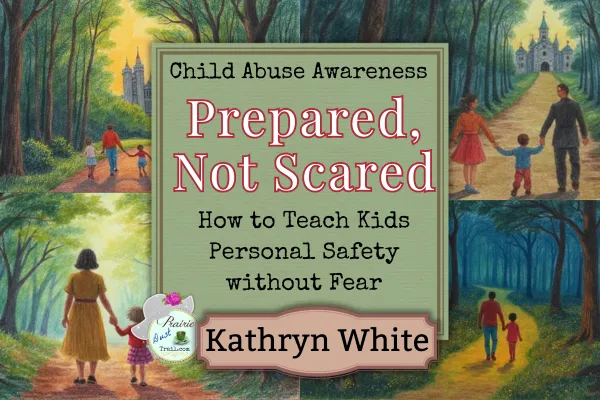
Prepared, Not Scared: How to Teach Kids Personal Safety (Without Fear or Fluff)
Real-world safety skills for kids, rooted in wisdom, awareness, and practical preparedness.
💙 April Is Child Abuse Prevention Month
You’ll see the blue ribbons. The posts. The statistics. And they matter, but if we’re being honest, prevention doesn’t just happen because we’re "aware". It happens because we prepare.
It happens in everyday conversations. In the boundaries we hold. In the skills we teach our kids before they ever need them. Because most harm doesn’t come with a warning label. It shows up in normal places, with familiar people, in situations that don’t look dangerous at first glance.
So if we really want to protect our kids—not just raise awareness—then we have to move from:
👉 “This is sad”
to
👉 “This is something I am actively preparing my child for”
That’s what this is about.
“The prudent see danger and take refuge, but the simple keep going and pay the penalty.” — Proverbs 27:12
Let’s go ahead and say the quiet part out loud:
A lot of us were taught safety in a way that doesn’t actually work.
“Don’t talk to strangers.”
“Be polite.”
“Respect adults.”
Sounds nice. Feels right. Also wildly incomplete. Because the reality? Most unsafe situations don’t come from strangers. And politeness is one of the main things that keeps kids quiet when something feels off.
If you’re someone who values preparedness—who stocks your pantry, makes a plan, and thinks ahead—this is part of that same mindset.
We’re not raising scared kids. We’re raising aware, prepared kids.
The Real Talk Most People Avoid
Listen, Cupcake: If your entire safety plan is “watch out for strangers,” your kid is underprepared.
Most harm comes from someone the child already knows.
Sometimes it’s an adult. Sometimes it’s another kid.
A cousin.
A friend.
A neighbor.
The “nice” one. The “fun” one.
Unsafe people don’t walk around looking like villains. They look normal. They act normal. They build trust first.
Which means your kid doesn’t need to learn how to spot “bad people.” They need to learn how to spot tricky behavior. That requires situational awareness and learning to separate behavior from people. That’s preparedness. That’s wisdom in action.
The 3 Rules That Actually Work
Simple. Clear. Repeatable.
1. No adult needs help from a child. Ever.
If a grown-up asks your kid for help—directions, finding something, carrying something—that’s a red flag.
2. No secrets from safe adults
Surprises are temporary. Secrets are meant to stay hidden.
3. Safety is more important than politeness
Your child is allowed to say no, walk away, or make a scene if they feel they are in danger.
Yes, even if it feels rude. And yes, even if it’s family.
Plot Twist: It’s Not Just Adults
This is where many families are unprepared: kids can also display unsafe or predatory behavior—especially when there’s:
Pressure
Secrets
Isolation
An age or power gap
So we teach this clearly:
“Most kids are kind. But sometimes kids make unsafe choices too. That’s why we pay attention to behavior—not just who it is.”
This isn’t paranoia. It’s paying attention and learning what red flags really are.
What to Actually Say (Because “Just Talk to Them” Isn’t a Plan)
You don’t need a lecture. You need repeatable conversations.
Start Here
“Hey—we’re going to talk about safety. Not because something is wrong, but because I want you to feel strong and ready in any situation.”
Adults Asking for Help
“If a grown-up asks you for help, what should you do?”
(Let them give some ideas. Guide them to the idea that grown-ups should ask another grown-up for help.)
“Grown-ups ask other grown-ups. You can say no and come find a safe adult.”
Secrets
“If someone says, ‘Don’t tell your parents,’ what does that tell you?”
Then: “Safe people don’t ask kids to keep secrets. If someone tells you not to tell me—you tell me anyway.”
Being “Rude”
“You do not have to be polite if something feels wrong.”
Give them permission: “You can say no. You can leave. You can yell.”
Now practice it: “Say it—‘NO! I don’t like that!’”
(Yes, out loud. Awkward builds muscle memory. Awkward practice now = confidence later.)
Other Kids
“If another kid says:
‘Don’t tell anyone’
‘If you’re my friend, you’ll do this’
‘Let’s go somewhere alone’
That’s not safe behavior. You can always come tell me.”
Parents, This Part Is For You
Let’s be clear on one thing: if someone in your life has a history of violence, manipulation, or unsafe behavior, your child should not be alone with them.
Not “just for a minute.”
Not “it’ll be fine this time.”
Not “we don’t want to make it awkward.”
Prepared families plan ahead. They don’t wait for proof after the fact. Your responsibility is not to protect adult feelings. It’s to protect your child.
Why Kids Don’t Tell
Kids stay quiet because:
They think they’ll get in trouble
They’re confused
They were told to keep a secret
They were threatened
And the one most parents underestimate: They think they’re protecting you.
“If you tell, I’ll hurt your mom.” A child will believe that. Which is why you must prepare them ahead of time.
What Your Child Needs to Hear—Clearly and Often
Don’t assume they know. Say it out loud, clearly, and often:
“You are NEVER in trouble for telling me anything.”
“If someone says they’ll hurt us if you tell—that is not true. I will handle it.”
“There is nothing you could say that would make me stop loving you or protecting you.”
And if you want to ground that in truth:
“God has not given us a spirit of fear, but of power, love, and a sound mind.” — 2 Timothy 1:7
That’s what we’re building here: Power. Love. Sound judgment.
🎯 The Goal
We are not trying to make children afraid or paranoid of their fellow humans. We want them to be prepared, aware, and safe. Now, and in the future.
We are raising children who:
Trust their instincts
Know they can say no
Know they can speak up
Know their safety matters more than someone else’s comfort
That’s how you raise a child who is harder to manipulate—and better equipped for the real world.
Want the Printable (and More Support)?
I’m putting together a simple, practical safety printable that includes:
A kid-friendly rhyme that sticks
A coloring page
Real-life scenario cards
A step-by-step parent guide
It’s not quite ready yet (because around here we do things well not fast), but here’s how you can stay in the loop and get more support:
👉 Join the Prairie Dust preparedness community here to get it as soon as it drops:
https://prairiedust.app.clientclub.net/communities/groups/prairie-dust-group/home?invite=69f01004bdb3be80119665de
👉 Want deeper support and coaching on having hard conversations, building awareness, and leading your family with clarity?
Join Clarity + Capacity Collective here:
https://prairiedust.app.clientclub.net/communities/groups/ccc/home?invite=69f01047271fe1ed0a88dafa
Because preparedness isn’t just about supplies. It’s about raising kids—and leading families—who are ready for real life.