How to Prepare Chickens for Winter: A Fall Coop Checklist
A practical fall chicken-keeping guide to preparing your coop, supplies, and backyard flock for cold weather—before you're doing emergency repairs in your pajamas.
Apparently September is National Chicken Month.
I don't know who decides these things, but after spending the month telling everyone to inventory their emergency supplies, take inventory of themselves, and get a library card, it seems only fair that we ask one final preparedness question:
Are your chickens prepared for the apocalypse?
Okay. Probably not the apocalypse. Let's start with winter.
Although, if you've ever watched an entire flock of chickens react to a plastic grocery bag blowing across the yard, you already know they're emotionally prepared for neither.
Fall is one of the best times to look over your chicken setup because winter has a funny habit of exposing every little problem you've been meaning to fix. The tiny roof leak isn't nearly as charming when it's dripping onto bedding during freezing weather. The waterer that was perfectly adequate in July becomes considerably less useful when it's a chicken-shaped ice rink. The latch you've been meaning to repair suddenly becomes much more concerning when hungry wildlife is also preparing for winter.
And the beautiful thing is that none of this is a surprise. Winter comes every year. Maybe that's our first lesson from the Prepper Chickens:
If you know something difficult is coming, do what you can while conditions are still good.
Start With the Coop
Before worrying about fancy winter chicken gadgets, go stand inside your coop. Seriously. Look up, look down, look around.
This is easier to do on a pleasant fall afternoon than at 6:30 on a January morning while wearing pajamas, a coat thrown over those pajamas, and whatever shoes you could find beside the door.
Check the roof for leaks. Look for loose boards, damaged hardware cloth, gaps around doors, weak latches, holes near the foundation, and places predators might exploit. Make sure roosts are secure and nesting boxes are in good condition. If you've been meaning to make a repair since spring, this is your friendly reminder that spring was several months ago, Cupcake. Fix it.
While you're there, think about ventilation.
This is one of those areas where our human instincts can get us into trouble. When cold weather comes, we want to button everything up as tightly as possible because that's what we'd want if we were sleeping in the coop.
Your chickens, however, are already wearing down coats. A healthy chicken can tolerate cold surprisingly well when it's dry, protected from harsh direct drafts, and acclimated to its climate. What causes problems is often moisture.
Chickens breathe. They poop. Their water spills. Moisture accumulates.
If we seal the coop tightly enough to "keep them warm," we can also trap humidity and ammonia inside with them. So the goal isn't an airtight chicken bunker. It's a coop that protects the flock from wind and weather while still allowing moisture and stale air to escape.
Protected from drafts does not mean deprived of ventilation.
Your chickens need fresh air even when it's cold. Frankly, after spending five minutes inside a poorly ventilated chicken coop, you'll understand why.
Give the Coop a Good Fall Cleaning
This is also a wonderful time for a good cleaning.
Remove old bedding as appropriate for the management system you use. Clean nesting boxes. Look underneath things. Check corners. Look for signs of rodents, mites, moisture, mold, or damage you've overlooked. Then put down clean, dry bedding and make sure you have enough bedding stored to get you through bad weather.
Because there are few things less appealing than realizing you need chicken bedding immediately after an ice storm. Ask me how I know. Actually, don't.
The point is that preparedness isn't always dramatic. Sometimes preparedness is simply buying the shavings before the weather turns ugly.
Water: The Winter Chicken-Keeper's Nemesis
Your chickens need access to clean drinking water in winter just as much as they do during the rest of the year. The complication is that water has this incredibly inconvenient habit of freezing when it gets cold.
Rude.
Now is the time to decide what your winter watering system will be.
Depending on your climate, coop setup, access to electricity, and the temperatures you're dealing with, that may mean heated waterers or bases designed for that purpose, swapping fresh water multiple times a day, keeping a second waterer ready to rotate, or another safe system that works for your situation.
The important part is not waiting until the first hard freeze to develop the plan. Check your waterers now.
Are they cracked? Do they leak? Are electrical cords and connections in good condition on equipment designed to be heated? Do you have a backup if your primary waterer fails? And if the electricity goes out during a winter storm, what will you do then?
There's our preparedness brain again. We aren't trying to imagine every conceivable disaster. We're simply asking:
What's likely to happen, and what would I do if it did?
Not the worst case scenario. Not the best case, either. Only what is the most likely scenario.
Check the Feed Situation
Fall is also a good time to look at how you're storing feed.
Cold weather often means rodents and other hungry little freeloaders become even more interested in whatever you've thoughtfully stored for your chickens.
Check your containers. Make sure feed stays dry. Look for signs that mice have discovered the buffet. Take inventory of whatever supplements or supplies you routinely use. And think realistically about how much feed you keep on hand.
You don't necessarily need six months of chicken feed stacked to the rafters. Feed doesn't improve with age, and storing more than you can protect from moisture, pests, and spoilage isn't particularly helpful.
But if a winter storm makes the roads unpleasant or impossible for several days, do you have enough to keep your flock fed without making an emergency trip?
That's the kind of question worth asking now.
Preparedness doesn't always mean more. Often it means enough.
Your Chickens Are Molting and Everyone Looks Terrible
If you're fairly new to chickens, autumn may also introduce you to one of the most alarming seasonal traditions in poultry ownership: Molting.
Dun, dun, DUN!
One day you walk outside and discover feathers everywhere. One chicken looks like she has exploded. Another looks personally offended by existence. Egg production may slow down. And suddenly you're Googling, Why is my chicken bald?
Welcome to fall.
Molting is the normal process of replacing old feathers with new ones, but it's still worth paying attention to your birds. Know what's normal for your flock so you can recognize when something isn't normal.
Look at their body condition. Watch how they're walking. Look at feet and legs. Check combs and wattles. Pay attention to eating and drinking. Watch for signs of parasites or injury. Notice whether one bird is isolating herself or behaving differently.
You don't have to spend every morning interrogating each hen about her bowel movements. But observation is one of the most useful animal-care skills you can develop.
Know what normal looks like before something goes wrong.
That applies to an awful lot more than chickens.
And if you're concerned about a bird's health or aren't sure whether something you're seeing is normal, consult a veterinarian or knowledgeable poultry-health professional rather than relying solely on Chicken Facebook, where the diagnoses will range from totally normal to your entire flock will be dead by Tuesday.
The internet contains multitudes.
Predator-Proof Before the Predators Get Hungry
Your chickens aren't the only creatures preparing for winter. Predators have to eat, too.
Walk your fence line. Check doors and latches. Inspect hardware cloth and other barriers. Look for digging around the coop. Pay attention to anything loose, warped, rusted, broken, or easier to open than it ought to be.
And remember that chicken wire is very good at keeping chickens in - it is not necessarily very good at keeping determined predators out.
What predators you need to prepare for depends on where you live, but the basic principle is universal: Don't wait until something gets into the coop to discover where the weakness was.
That's a miserable lesson. Find the gaps while the flock is still safe.
Do Your Chickens Need Heat?
Ah yes. The Great Winter Chicken Debate. Mention supplemental heat in a group of chicken keepers and you may accidentally start a small civil war.
The frustrating but responsible answer is: It depends.
Climate matters. Breed matters. Age and health matter. Coop construction matters. Ventilation matters. Humidity matters.
What counts as "cold" in one region may be an unusually pleasant winter day somewhere else.
Many healthy, cold-hardy adult chickens can handle temperatures much colder than people expect when they have appropriate shelter, dry bedding, protection from direct wind, good nutrition, liquid water, and time to acclimate.
That doesn't mean no chicken anywhere ever needs supplemental heat. It means heat shouldn't automatically be the first solution simply because the thermometer dropped.
Any electrical or heating equipment used around a coop also introduces another consideration: Fire.
Dry bedding, dust, feathers, electricity, extension cords, and improvised heating equipment can be an ugly combination. So don't hang a random heat lamp over dry bedding because somebody online told you chickens are cold at 40 degrees.
Research the needs of your breeds in your climate, evaluate your coop, use equipment designed and installed for the environment when needed, and ask a knowledgeable local poultry keeper or veterinarian when you're uncertain.
Good preparedness isn't copying somebody else's setup. It's understanding your own.
Make a Chicken Emergency Plan
Here's where we're going full Prepper Chicken.
Imagine it's January. There's ice on the roads. The power goes out. The water freezes. You have enough groceries for your family, so nobody needs to go anywhere.
Wonderful.
But...
What about the chickens? Do you have feed? Can you provide water without electricity? Can you safely get to the coop? Do you have bedding?
What if you're sick? What if you're out of town when bad weather moves in? Does anyone besides you know how to care for the flock?
This is the part of preparedness people tend to forget. If your entire animal-care system depends on one person being healthy, home, mobile, and available every single day, you don't actually have much of a backup plan.
Teach somebody else. Write down the basic routine. Show your spouse or an older child where the feed is. Explain how much to give. Show them how the doors and latches work. Make sure another trusted person knows enough about your setup that they could keep everyone alive for a few days if you couldn't.
You don't need a 47-page Chicken Emergency Operations Manual (although I'm sure somebody on Etsy sells one).
You just need a backup.
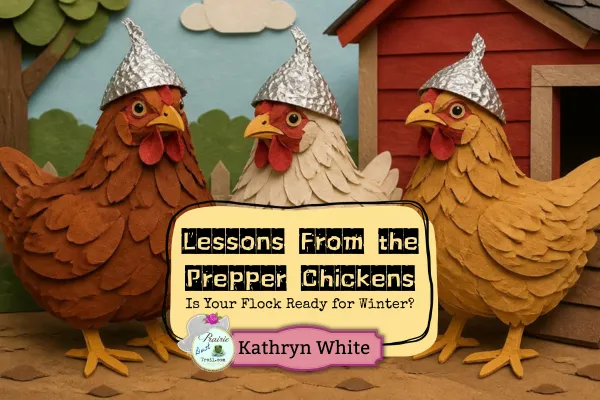
Lessons From the Prepper Chickens
The more I thought about preparing chickens for winter, the more I realized chickens are surprisingly decent preparedness teachers. Not because they're particularly wise... Heh... let's not get carried away. These are animals that will sometimes stand in their water dish and then act personally betrayed because their feet are wet.
But there are still a few things worth noticing:
Prepare before the weather changes. Winter is considerably easier when you've repaired the roof, stored the bedding, figured out the water, and bought the feed before the forecast gets ugly. Many emergencies become less dramatic when we handle predictable problems early.
Community matters. Chickens are flock animals. They watch one another, warn one another, follow one another, squabble over completely unnecessary things, and then settle down together when the day is done. Honestly, that sounds remarkably like church.
Don't follow the loudest chicken just because she's loud. I don't even need to explain that one.
Know what normal looks like. When you regularly observe your flock, changes stand out. The same is true of our homes, finances, health, relationships, and communities.
Keep enough. Enough food. Enough water. Enough bedding. Enough margin that one bad day doesn't immediately become an emergency.
Maintenance is preparedness. Fix the latch. Clean the waterer. Patch the roof. Replace what's broken. The boring little jobs are often what keep a difficult situation from becoming a crisis.
Maybe that's the biggest lesson. Preparedness usually isn't dramatic. It's ordinary people doing ordinary things before they're urgently needed.
Do It Before You're Wearing Pajamas and Crocs
If you've been following Prairie Dust Trail this month, you may have noticed a theme.
We started by taking inventory of our emergency supplies.
Then we took inventory of ourselves.
We talked about libraries and the importance of knowing how to find information when we don't know something yet.
And now we're apparently taking inventory of chickens.
Welcome to Prairie Dust Trail.
But all four conversations really come back to the same thing: Stewardship.
Pay attention to what God has placed in your care. Know its condition. Maintain it. Learn what you don't know. Prepare for the things you reasonably can. And then don't spend the rest of your life panicking about everything you can't control.
So sometime this fall, before the first miserable cold morning arrives, grab a cup of coffee and walk out to the coop. Look at the roof. Check the latches. Inspect the waterers. Look at your feed. Watch your birds. Think through what you'd do during a winter storm.
Fix the little things now. Because no true Prepper Chicken wants to be standing outside in January wearing pajamas, Crocs, and one glove while trying to thaw a frozen waterer while Bessie the Lil Red Hen suffers from frostbite and judges your PJs.
Actually, the chickens won't care what you're wearing. They'll just be yelling because breakfast is late.
Some things cannot be prepared for.
Come Hang Out With Us
If you like your preparedness with a little less panic and a little more real life, come join us on the Prairie Dust Trail Substack.
We talk about practical preparedness, homemaking, homesteading, homeschooling, faith, family, old-fashioned skills, and the everyday things that help us build more resilient homes and lives.
And, apparently, occasionally... Prepper Chickens.
Subscribe and come along. We're learning as we go, preparing where we can, trusting God with the rest—and trying not to get outsmarted by poultry.