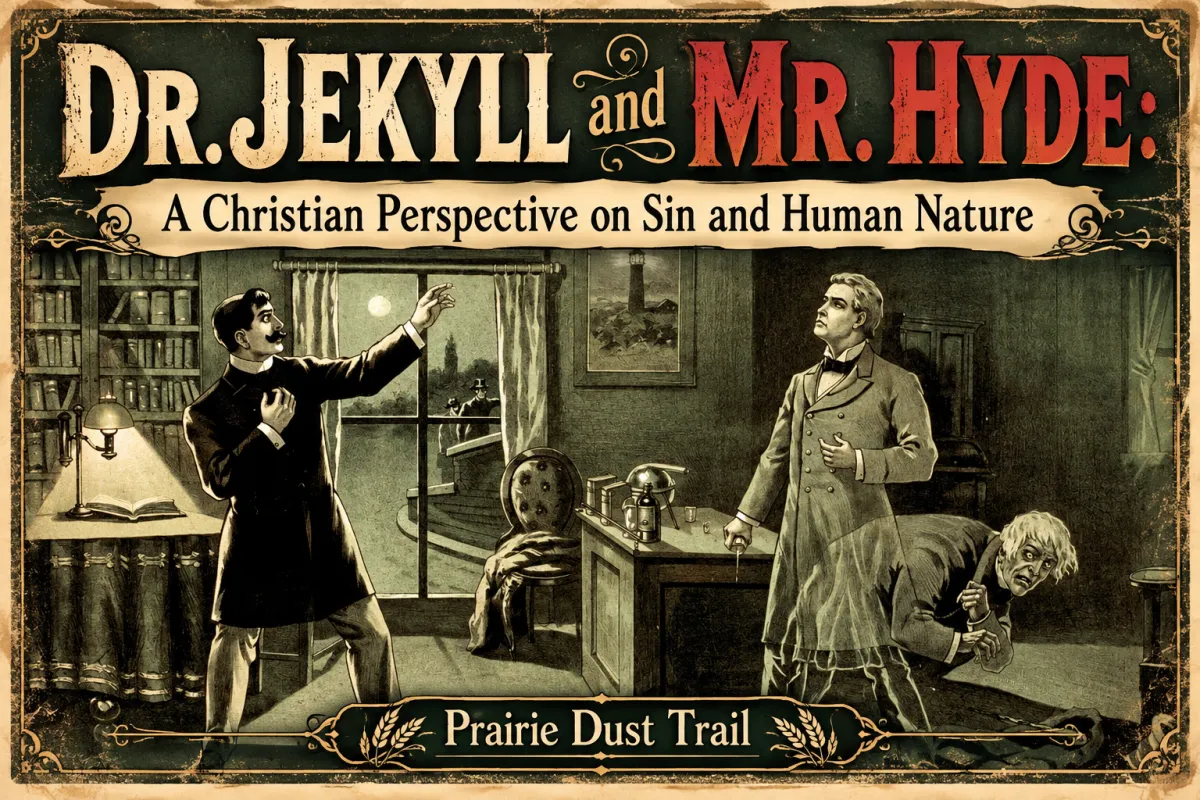
Dr. Jekyll and Mr. Hyde: A Christian Perspective on Sin and Human Nature
What Robert Louis Stevenson's classic story can teach Christians about sin, secrecy, divided hearts, and the dangerous belief that we can indulge one part of ourselves without changing the rest.
October has arrived at Prairie Dust Trail, which means we're doing something a little different with our Old Stories, Timeless Wisdom series.
We're reading spooky books.
Not because we've suddenly decided to turn Prairie Dust Trail into a horror blog, and not because we're particularly interested in being frightened for the sake of being frightened. Instead, I want to spend October looking at some of the old stories Christians sometimes hesitate to pick up—the ones filled with monsters, darkness, death, temptation, strange experiments, supernatural evil, and things that go bump in the night—and ask what these stories are actually saying.
Because human beings have been telling stories about monsters for a very long time.
And sometimes the most interesting question isn't, "What is the monster?"
It's "Why does this particular monster frighten us?"
Robert Louis Stevenson's Strange Case of Dr. Jekyll and Mr. Hyde gives us an especially uncomfortable answer. The monster isn't lurking in the woods. He isn't hiding beneath the bed. He doesn't crawl out of an ancient tomb or arrive from some distant land.
The monster is already in the house. And worse, Dr. Jekyll invited him in.
The Story We Think We Know
Even if you've never read The Strange Case of Dr. Jekyll and Mr. Hyde, you probably know the basic idea. Dr. Henry Jekyll is the respectable doctor, and Mr. Edward Hyde is his evil alter ego. Jekyll drinks a potion, transforms into Hyde, does terrible things, changes back, and eventually loses control of the monster he created.
We've absorbed the story so thoroughly into popular culture that "Jekyll and Hyde" has become shorthand for someone who seems to have two completely different personalities.
But the original story is considerably more interesting than that.
Jekyll doesn't accidentally create Hyde while innocently conducting a chemistry experiment. He has spent much of his life wrestling with what he describes as the two sides of his nature. He has a public reputation to maintain, desires he is ashamed of, and an increasing fascination with the possibility that these parts of himself might somehow be separated.
He imagines what freedom that could offer. The respectable Dr. Jekyll could remain respectable, the darker part of himself could have its pleasures, and neither would have to answer for the other.
That's the part of the story that ought to make us squirm a little. Because Jekyll's great mistake isn't simply that he discovers how to become Hyde. It's that he wants Hyde to exist.
Jekyll Doesn't Want to Kill the Monster
At first, Jekyll doesn't particularly want to become a better man. He wants to become a man who can sin without consequences. That's different.
He wants to preserve the honorable identity he has built while creating another identity that can indulge desires that would damage his reputation, relationships, and conscience. Hyde gives him anonymity. Hyde can go where Jekyll shouldn't go, do what Jekyll shouldn't do, and pursue things Jekyll doesn't want attached to his own name. Then Jekyll can transform back, walk through his respectable front door, and continue being Dr. Henry Jekyll.
It's a remarkably modern temptation for a book published in 1886.
We may not have mysterious chemical potions bubbling in our laboratories, but human beings have become very good at compartmentalizing ourselves. Or, perhaps we have always been good at it.
There is the person we are at church and the person we are at home. The person we are in public and the person we become behind a screen. The things we would say with our name attached and the things we would say anonymously. The habits we defend because "nobody knows." The resentment we nurture privately while behaving graciously in public. The secret spending, secret drinking, secret messages, secret fantasies, secret bitterness, secret browser history, or secret little corner of life that we insist has nothing to do with everything else.
We tell ourselves that this icky part stays over here in a special box; it doesn't affect my marriage, my parenting, my faith, or my character. It doesn't affect who I really am.
Jekyll believes essentially the same thing. He thinks Hyde can carry Jekyll's sin while Jekyll keeps Jekyll's identity.
But character doesn't work that way.
You Cannot Feed Hyde Without Changing Jekyll
One of the most chilling parts of Stevenson's story is that Hyde initially seems smaller and younger than Jekyll. Jekyll interprets this as evidence that the evil side of his nature has been less developed because he has spent most of his life restraining it.
But Hyde doesn't stay powerless. Jekyll gives him room. Then he gives him time. Then he gives him freedom. And Hyde grows stronger.
Eventually Jekyll begins changing into Hyde without choosing to. What began as something he deliberately turned on and off becomes something that happens to him. The indulgence he believed he controlled begins controlling him.
That progression should sound familiar even if we've never touched anything resembling Jekyll's potion.
Scripture repeatedly warns us that what we practice shapes us. James describes desire conceiving and giving birth to sin, and sin eventually bringing forth death. Paul warns against becoming enslaved to sin. Proverbs repeatedly shows choices becoming paths, and paths becoming destinations.
We tend to think of sin as a collection of isolated incidents: I did this thing. I shouldn't have done this thing. Now that thing is over.
Sometimes it is helpful to think instead about formation: What am I practicing becoming?
Every time Jekyll becomes Hyde, becoming Hyde becomes easier.
That's one of the uncomfortable truths hidden inside the horror story. The things we repeatedly indulge don't necessarily remain occasional things we do. They can become patterns, reflexes, appetites, habits, and eventually pieces of the person we're becoming.
This is true of obvious destructive habits, but it's also true of quieter things. Practice resentment long enough and resentment becomes your default interpretation of other people's motives. Practice outrage long enough and peace begins to feel boring. Practice dishonesty long enough and telling the truth becomes threatening. Practice avoiding discomfort long enough and ordinary responsibilities begin to feel unbearable.
We are always practicing something. The question is whether we're practicing becoming the kind of person we actually want to be.
"For I Do Not Do the Good I Want..."
It's difficult to read Jekyll and Hyde as a Christian without eventually thinking about Romans 7. Paul writes about the bewildering contradiction within human nature: "For I do not do the good I want, but the evil I do not want is what I keep on doing."
The struggle is real!
Most of us know what it's like to sincerely want one thing and then watch ourselves choose another. We decide we're going to be patient and then hear our own voice snap at someone fifteen minutes later. We decide we're finished gossiping and somehow find ourselves halfway through a sentence that absolutely qualifies. We decide we're going to stop scrolling, stop overspending, stop avoiding, stop losing our temper, stop replaying the offense, stop eating the thing, stop saying yes when we mean no, or finally do whatever responsible thing we've been avoiding.
And then there we are again.
That doesn't mean we have a literal Mr. Hyde living inside us. It means Christianity has never been particularly sentimental about human nature. Scripture doesn't teach that human beings are basically perfect creatures who occasionally make inexplicable mistakes because somebody failed to provide enough positive affirmations.
We are made in the image of God. We are capable of tremendous love, courage, creativity, sacrifice, beauty, generosity, and goodness.
And we are fallen.
Those truths exist together.
The Christian answer to that uncomfortable reality isn't self-hatred. It isn't pretending we're secretly monsters. And it certainly isn't dividing ourselves into a respectable person and an unacceptable person, then hiding the latter in a back room.
The answer begins with truth.
Sin Grows Particularly Well in the Dark
Jekyll's arrangement depends upon secrecy.
Hyde has his own entrance. His own movements. His own identity.
Jekyll creates practical ways for Hyde to exist without disrupting Jekyll's respectable life, right down to making financial arrangements for him.
There's something almost absurd about it when you step back; Jekyll is essentially doing administrative work for his own secret sin.
And yet... We do versions of this, don't we?
We rearrange things so nobody asks questions. We delete things. We develop explanations in advance. We carefully avoid particular subjects. We keep different groups of people from comparing notes. We create passwords, private accounts, hidden purchases, separate stories, convenient omissions, or elaborate rationalizations.
Not always because we're hiding some enormous scandal, either. Sometimes we're simply protecting something we already know we shouldn't be feeding.
One of the reasons confession matters in Christian life is that sin loves isolation. Bringing something into the light breaks the illusion that it can remain safely compartmentalized.
James tells believers to confess their sins to one another and pray for one another. First John repeatedly uses the language of walking in the light rather than darkness. Christianity isn't built around maintaining the appearance that good Christians never struggle. It's built around the astonishing news that we don't have to hide.
That doesn't mean confessing every private thought to every person we meet. Wisdom and appropriate privacy still matter. But there is a significant difference between privacy and secrecy.
Privacy protects something appropriately personal. Secrecy protects something because exposure would threaten our ability to continue it.
That's worth thinking about.
The Lie of "This Doesn't Affect Anyone Else"
Jekyll's experiment also depends on another lie: that he can contain the consequences. Hyde belongs to Jekyll, but Jekyll imagines that Hyde's actions can somehow remain separate from him. They don't.
Other people suffer. People become frightened. Relationships become tangled in the consequences. Eventually someone dies. Jekyll discovers that the line between "my private choices" and "what affects other people" is not nearly as sturdy as he thought.
We sometimes need that reminder, especially in a culture that treats personal freedom as the final argument for almost everything. Our choices form us, and the people closest to us live with the person we are becoming.
My bitterness may happen inside my head, but my family eventually lives with the sharpness it produces.
My refusal to deal with my finances may feel private until someone else has to help clean up the crisis.
My habit of avoiding difficult conversations affects the people who are left guessing.
My refusal to rest affects the people who live with me when I'm exhausted and irritable.
My dishonesty forces other people to make decisions based on information that isn't true.
My inability to say no may eventually turn into resentment toward people who never realized I didn't want to say yes.
None of us lives in complete isolation. That's not meant to produce paranoia over every imperfect decision. It's simply an invitation to remember that character is relational. Who we are affects the people we love.
But Christianity Doesn't End With "Try Harder"
This is where I think the Christian reading of Jekyll and Hyde becomes especially important. If the only lesson we take from the story is "You have evil tendencies, so control yourself better," we've stopped far too soon.
Jekyll tries that.
After Hyde commits a particularly terrible act, Jekyll is horrified enough to swear him off. For a while he reforms. He returns to charitable work. He reconnects with friends. He behaves himself. But Hyde is still there. Jekyll hasn't actually dealt with the thing that made Hyde appealing to him in the first place. He's merely locked the door again. Eventually temptation returns, and because Jekyll still believes he can control the arrangement, he opens it.
Christianity offers something far more radical than behavior management.
The gospel doesn't say, "Construct a sufficiently respectable Dr. Jekyll and keep Mr. Hyde under control." It says we need to be made new.
Paul doesn't finish Romans 7 by shrugging and saying, "Well, apparently I'm terrible. Better try harder tomorrow." He cries, "Wretched man that I am! Who will deliver me from this body of death?"
And then comes the answer: "Thanks be to God through Jesus Christ our Lord!"
Romans 8 begins with no condemnation for those who are in Christ Jesus and goes on to describe life in the Spirit. That's a very different solution from Jekyll's.
Jekyll wants separation.
Christ offers transformation.
Jekyll wants a respectable self and a secret self.
Christ calls us toward wholeness.
Jekyll wants freedom to indulge desire without consequence.
Christ offers freedom from being mastered by it.
That's much better news than simply being told to keep Hyde on a shorter leash.
Maybe the Monster Story Is a Mirror
There's a reason Dr. Jekyll and Mr. Hyde has survived. The potion isn't particularly frightening anymore. Modern readers aren't likely to spend sleepless nights worrying that their neighborhood physician has discovered a chemical formula that turns him into a smaller, hairier criminal.
Hyde remains unsettling because we recognize something in him. We know what it is to discover something ugly in ourselves that doesn't match the person we thought we were. We know what it is to rationalize. We know what it is to say, just this once. We know what it is to think, I can stop whenever I want. We know what it is to carefully protect an image while quietly making allowances for things that contradict it.
Maybe this is how monster stories can be useful. Sometimes a monster gives shape to something we'd rather not look at directly. The best monster stories aren't merely asking whether evil exists somewhere out there. They're asking what we do when we discover its fingerprints much closer to home.
Christianity gives us permission to answer that question without either pretending we're innocent or deciding we're hopeless.
Yes, human beings are fallen.
Yes, sin is real.
Yes, what we practice matters.
Yes, secrecy can make destructive things stronger.
But none of that is the end of the story.
We don't have to create another identity to carry the things we're ashamed of. We don't have to protect our respectable image at all costs. We don't have to pretend. We can bring what is hidden into the light. We can confess. We can repent. We can ask for help. We can practice something different.
And, most importantly, we can trust that the God who already knows exactly what's behind the respectable front door isn't standing outside waiting for us to get the house cleaned up before He comes in.
Old Stories, Timeless Wisdom
That's what I love about returning to old stories. Dr. Jekyll and Mr. Hyde was published in 1886, but Stevenson was writing about something considerably older than Victorian London.
The divided human heart isn't new. Neither are secrecy, temptation, rationalization, shame, appetite, or the desire to enjoy sin without paying its bill.
The clothes change. The technology changes. The hiding places change. Human nature remains remarkably recognizable.
So if you read The Strange Case of Dr. Jekyll and Mr. Hyde with us this October, don't just look for the monster. Look for the man who keeps opening the door for him.
And perhaps ask yourself a gentler but more useful question than, "What is wrong with Jekyll?"
Ask: What am I practicing becoming?
Not, What mistake have I made? Not, What ugly thought proves I'm secretly awful? Not even, What part of myself do I need to hide better?
What am I repeatedly feeding? What am I practicing? What becomes easier every time I choose it? What am I keeping in the dark because bringing it into the light would require me to change? And what might happen if, instead of spending all that energy managing two versions of ourselves, we let God begin making us whole?
That's a considerably more hopeful ending than Dr. Jekyll gets.
And we're only getting started with the monsters!
Next up in our Spooky Old Stories, Timeless Wisdom October series: Mary Shelley's Frankenstein.
Because apparently after asking whether the monster is already inside the house, the next logical question is: What happens when we decide we'd like to make one ourselves?
When You're Tired of Repeating the Same Patterns
Of course, most of us aren't hiding a murderous alter ego behind a secret door.
But you may have finished this article thinking about a pattern in your own life that you keep returning to: the boundary you know you need but can't seem to hold, the resentment you keep feeding, the responsibility you keep avoiding, the people-pleasing that turns into frustration, the family dynamic that pulls you right back into an old version of yourself, or simply that frustrating feeling of, "I know I don't want to keep doing this. So why do I keep doing it?"
That's the kind of thing we can untangle in life coaching.
Through Okie Dokie Life Coaching, I help overwhelmed adults create enough space to think clearly about what's actually happening, what belongs to them, what doesn't, and what they want to do differently. My approach is practical, conversational, faith-friendly, and focused less on beating yourself up for how you got here and more on figuring out what your next faithful step looks like.
You don't need to arrive with a perfectly defined goal, a twelve-step plan, or a dramatic personal transformation already underway. Sometimes we start with something as simple as: "I keep ending up here, and I don't want to anymore."
That's enough to have a conversation.
If something in this post hit a little closer to home than you expected, you can start with a free 15-minute Clarity Call. We'll talk about what's going on, what you'd like to change, and whether coaching might be a useful next step.
No mysterious potions required! Honestly, those seem to cause more problems than they solve...