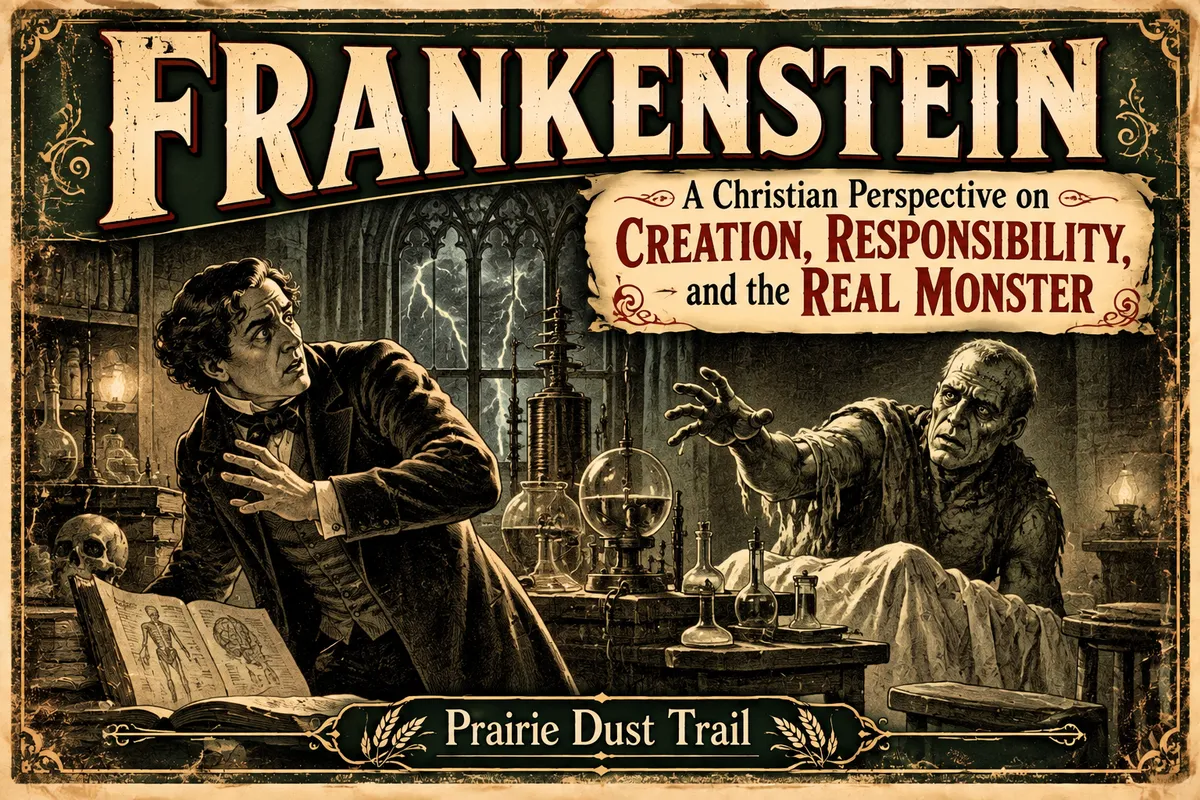
Frankenstein: A Christian Perspective on Creation, Responsibility, and the Real Monster
What Mary Shelley's Frankenstein can teach Christians about creation, responsibility, rejection, bitterness, and the dangerous desire to possess God's power without God's character.
Last week, we began our spooky October edition of Old Stories, Timeless Wisdom with Dr. Jekyll and Mr. Hyde, a story that asks us to look uncomfortably close to home and consider what happens when we keep feeding the parts of ourselves we'd rather pretend aren't there.
This week, we're making a monster. Or, more accurately, Victor Frankenstein is. And if your entire understanding of Frankenstein comes from old movies, Halloween decorations, and a green fellow with bolts sticking out of his neck, Mary Shelley's original novel may surprise you.
First, Frankenstein is the scientist.
I know. Some of you already knew that. But, some of you have been confidently calling the Creature "Frankenstein" your entire life and are now experiencing a small literary crisis.
It's okay. This is a safe place. 😂
Second, the Creature isn't a lumbering, groaning brute who wanders around with his arms stretched in front of him. He is intelligent. He learns language. He reads. He reasons. He observes human relationships from a distance and longs desperately to participate in them. He thinks about God, humanity, good and evil, belonging, justice, and his own existence.
And third, Victor Frankenstein's greatest failure isn't necessarily that he creates life. It's what he does afterward. He runs away.
Victor wants the power of a creator. He just doesn't want the responsibility of one.
And that is where this old monster story starts asking some remarkably modern questions.
"What If I Could?" Is Not the Same Question as "Should I?"
Victor Frankenstein is fascinated by the secrets of life. He becomes consumed with discovering how living things are formed and how life might be restored to dead matter. He isolates himself, neglects his health and relationships, and pursues his work with the kind of single-minded obsession that can make ambition look almost virtuous from the inside.
After all, he's learning. He's discovering. He's accomplishing something no one else has accomplished. He's pushing the boundaries of human knowledge. And then he succeeds.
That's the moment where most simplified versions of the story focus: lightning flashes, machinery crackles, the Creature moves, and Victor cries something dramatic while the soundtrack loses its mind.
But Shelley's story is much quieter and much more disturbing; Victor gets what he wanted. The Creature opens his eyes. And Victor is horrified. The beautiful future he imagined disappears the moment his experiment becomes an actual living being standing in front of him.
So Victor leaves.
He creates life and then abandons it because the reality of his creation is uglier, messier, and more demanding than the glory he imagined while pursuing it. That's worth sitting with.
Human beings are remarkably good at asking, "Can we?"
Can we build it? Change it? Produce it? Make it faster? Bigger?
Those aren't necessarily bad questions. Curiosity, creativity, discovery, medicine, science, art, engineering, and innovation are all expressions of capacities God gave human beings.
But wisdom requires another question: Should we?
And perhaps another after that: If we do, what responsibility will we have for it?
Power and wisdom aren't the same thing. Ability and permission aren't the same thing. Achievement and goodness aren't the same thing.
Victor learns how to create life before developing the character necessary to care for the life he creates.
That's a dangerous combination.
Victor Wants the Power of God Without the Character of God
This is where Frankenstein becomes especially interesting from a Christian perspective. The problem isn't simply that Victor "plays God." Christians use that phrase rather casually sometimes, especially whenever science makes us uncomfortable.
Human beings are actually commanded to exercise a kind of creative stewardship in Genesis. Creativity and ownership itself isn't rebellion against God. It reflects something about being made in the image of a Creator.
The problem with Victor is that he wants creative power separated from loving responsibility.
Compare his response to his creation with God's response to His.
Genesis doesn't describe God creating humanity and then recoiling because Adam didn't turn out quite as expected. Instead, God provides. God speaks. God gives purpose. God establishes relationship.
Even after humanity rebels, the rest of Scripture tells the story of a God who continues pursuing, correcting, judging, rescuing, covenanting, providing, and ultimately entering His own creation to redeem it.
Victor does almost the opposite. He brings a conscious being into existence and immediately makes that being's existence somebody else's problem. He doesn't name him, doesn't teach him, doesn't protect him, doesn't guide him, doesn't introduce him to the world, and certainly doesn't take responsibility for what he has done. Victor wants to be creator right up until creation needs something from him. Then he would very much like to unsubscribe.
There is something painfully human about that.
We often enjoy the parts of responsibility that make us feel powerful, needed, accomplished, or important. We are less enthusiastic about the parts that require patience, consistency, humility, sacrifice, repair, and showing up after the exciting part is over.
It's easy to love starting. It's harder to love tending. But stewardship is mostly tending.
The Creature Begins With a Desire for Good
One of the saddest parts of the novel is discovering that the Creature isn't born murderous.
He is confused. Cold. Hungry. Alone. He has no idea what he is or why he exists. He gradually learns by observing a family from hiding. He watches affection and sacrifice. He learns language. He secretly helps them. He reads books. He begins understanding human society, and the more he understands it, the more painfully aware he becomes that he has no place in it.
He wants companionship. He wants someone to see him without recoiling. He wants to belong. Instead, people see his appearance and respond with fear or violence.
Eventually the Creature asks Victor a devastating question in essence: Why did you make me if you were going to hate me for existing?
That's where Frankenstein becomes much harder than a simple story about an evil monster, because the Creature has been profoundly wronged.
His creator abandoned him. People reject him before knowing him. He experiences loneliness that would break many of us. His anger, grief, and longing makes sense. Even his bitterness makes sense.
And then he begins doing terrible things.
Both of those truths matter.
Understanding the Wound Does Not Excuse What We Do With It
This may be one of the most useful things Frankenstein gives us to think about: We can understand why someone became destructive without pretending their destruction is acceptable.
The Creature's suffering matters. Victor's abandonment matters. If we ignore those things and simply announce, "The Creature is evil," or "Victor was a horrible person" we miss half the story.
But if we look at the suffering and conclude that therefore the Creature bears no responsibility for murder, revenge, manipulation, and deliberate cruelty, we miss the other half.
Pain explains many things, but it doesn't automatically excuse them.
That's an important distinction in real life, too.
Someone may have learned manipulation because manipulation once helped them survive. Someone may lash out because they've been hurt. Someone may be terrified of abandonment because people really did abandon them. Someone may control because uncertainty once felt dangerous. Someone may avoid conflict because conflict in their childhood home was frightening. Someone may struggle to trust because people who should have been trustworthy weren't.
Those stories matter. Compassion asks us to understand them. But compassion doesn't require us to pretend harmful behavior stops being harmful once we know where it came from.
We can say: "I understand why this is hard for you, AND you still cannot treat me this way."
Those two ideas can exist in the same sentence.
The Creature deserved compassion. His victims didn't deserve to become payment for the compassion he didn't receive.
Hurt People Can Hurt People—But They Don't Have To
We've probably all heard the phrase "hurt people hurt people." There's truth in it.
Pain that isn't dealt with often spills somewhere. But I sometimes worry that we've started treating the phrase as though it's a law of nature.
Hurt people can hurt people. They can also become extraordinarily compassionate people. They can become protectors. They can become cycle-breakers. They can become people who say, "Because I know what this feels like, I refuse to inflict it on someone else."
The Creature has moments when another path still seems possible. That's part of what makes his descent tragic. He doesn't merely suffer until evil automatically happens. He begins making choices about what his suffering will mean. He decides that because he has been miserable, Victor should be miserable. Then he deliberately sets about making that happen.
Pain becomes entitlement. Entitlement becomes revenge. Revenge becomes identity.
At some point, the Creature stops merely saying, "Look what they did to me," and begins saying, in effect, "Now I will make them hurt."
That's the point where victimhood can become its own kind of prison.
What happened to us matters. It may explain fears, reactions, habits, defenses, and wounds that take years to understand. But if we build our entire identity around what someone else did to us, we hand that person an astonishing amount of power over who we become next.
Christianity gives us a different possibility. We are not required to pretend the wound didn't happen. We are not required to call evil good. We are not required to reconcile with unsafe people simply because they hurt us from their own place of pain. But neither are we required to become whatever our wounds seem to demand.
We can grieve, tell the truth, establish boundaries, seek justice where appropriate, ask for help - we can heal. And, with God's help, we can choose not to hand our pain to the next person.
Who Is the Monster?
This is the question that follows Frankenstein everywhere. Is Victor the real monster? Is the Creature?
The tempting answer is to be clever and say, "Victor was the monster all along." And there's certainly an argument to make.
Victor is selfish, obsessive, irresponsible, secretive, and cowardly. He abandons the being he created and repeatedly fails to take responsibility for consequences he helped set in motion.
But if we decide Victor is the monster and therefore the Creature isn't, we've created another oversimplification.
The Creature murders innocent people. He knowingly inflicts suffering. He understands enough about human morality to know what he's doing. He deliberately chooses revenge.
Maybe the uncomfortable answer is that the story contains more than one kind of monstrosity.
Victor's monstrosity appears in irresponsibility, pride, and abandonment. The Creature's appears in revenge, cruelty, and the decision to make innocent people suffer because he has suffered. Neither one's wrongdoing erases the other's.
That's a useful principle far beyond Gothic literature.
We have a tendency to approach conflict as though identifying the person who was wronged first settles every moral question that follows. Sometimes it doesn't.
A person can be genuinely wronged and later do something wrong. A parent can fail a child, and that grown child can still become responsible for how they treat others. A spouse can behave badly, and the other spouse's retaliation can still be wrong. Someone can manipulate us, and we can respond in a way we later need to repent of.
Responsibility isn't a pie with only enough slices for one person. Sometimes everybody involved has something they need to own.
The Creature Needed More Than a Creator
There's another thought I can't shake when reading this story.
The Creature doesn't merely need someone who made him. He needs someone who will father him. Someone to tell him who he is. Someone to teach him how to live. Someone to correct him. Someone to love him. Someone to establish boundaries. Someone to help him understand the strange world into which he has awakened. Victor gives him existence and nothing else. And human beings need more than existence.
One of the deepest threads running through Scripture is that God doesn't merely identify Himself as our Maker. He reveals Himself as Father.
That distinction matters.
A maker can build something and walk away. A father remains relationally involved.
Obviously every human analogy for God eventually reaches its limits, and Frankenstein isn't a Christian allegory. We don't need to force every character into a theological role Shelley never intended. But the contrast is still striking.
Victor's creation awakens and discovers that his creator is ashamed of him. Christianity tells us that we awaken into a world made by a God who already knew us and knows us completely.
Psalm 139 speaks of being formed and known by God. Jesus describes a Father who knows what His children need. Romans tells us that nothing can separate those in Christ from the love of God.
The Creature's tragedy begins with the question: "Why did you make me if you didn't want me?"
The Christian doesn't have to live with that uncertainty.
Be Careful What You Create
Most of us will never assemble a person out of assorted body parts and bring him to life in an upstairs laboratory.
I feel reasonably confident saying that.
But all of us create things - Families. Businesses. Projects. Systems. Habits. Expectations. Online communities. Ministries. Debts. Commitments. Relationships. Technology. Cultures inside our homes.
And every creation carries some kind of responsibility.
Sometimes we create situations because we like the exciting beginning without considering what maintaining them will require. We say yes because the opportunity feels good and then resent the responsibility attached to it. We start programs nobody has capacity to maintain. We bring animals home without thinking through their long-term care. We make financial commitments based on today's enthusiasm and tomorrow's imaginary income. We build businesses that depend on us being available every waking hour. We create family patterns because they're convenient when our children are small and discover later that they're difficult to undo.
Then one day we look at the thing we've built and think: Oh. This needs something from me.
That's when character matters more than ambition.
Before creating something, perhaps we should ask not only: Can I do this? But also: Am I willing to tend it?
And, if we find we have already created something, we need to ask: How can I tend this responsibly?
Old Stories, Timeless Wisdom
Mary Shelley published Frankenstein in 1818, when she was only twenty years old. More than two centuries later, we're still arguing about the questions inside it.
What responsibility accompanies knowledge? Does our ability to do something mean we should? What does a creator owe his creation? How much responsibility do we bear for the people we hurt? How much responsibility do wounded people bear for what they do with their wounds? Can suffering explain evil without excusing it? And what actually makes someone a monster?
Those aren't questions about a green Halloween decoration with bolts in his neck. They're questions about us.
Maybe that's why these old monster stories endure. The monster gives us enough distance to look at something uncomfortable. Dr. Jekyll let us examine the darkness we try to compartmentalize. Frankenstein asks us to examine the things we create, the responsibilities we'd rather abandon, and what happens when pain becomes permission to cause more pain. And once again, Christianity gives us a more hopeful answer than the monster story does.
We don't worship a Creator who recoils from what He has made. We don't worship a God who abandons us the moment humanity becomes messy. We worship the God who enters the mess. The God who calls Himself Father. The God who takes responsibility not for evil He committed, but for rescuing people who did. The God who doesn't merely tell wounded people to stop hurting.
He heals. He corrects. He transforms. He teaches us how to become something other than what our wounds might have made us.
So perhaps the question to carry away from Frankenstein isn't simply: Who is the real monster? But perhaps: What am I responsible for now?
Not everything that happened to me. Not everything another person chose. Not every consequence I can trace back through generations of complicated people making complicated decisions.
What is mine now?
What have I created that needs tending? What choice belongs to me? What pain needs healing instead of handing off? What responsibility have I been avoiding because I don't like what it requires of me?
Those questions aren't nearly as dramatic as bringing the dead to life in a secret laboratory. But answering them may keep us from creating a few monsters of our own.
Next in our Spooky Old Stories, Timeless Wisdom series, we're leaving the laboratory and heading toward Transylvania! Because after discovering the monster inside ourselves and then creating one ourselves, apparently the next reasonable step is to meet one who wants to drink our blood.
Bram Stoker's Dracula is next.
October is going splendidly.
Want to Keep the Conversation Going?
If you've enjoyed our Old Stories, Timeless Wisdom series—or the other conversations we have here about faith, preparedness, family, homemaking, homeschooling, old-fashioned skills, and learning to tend what God has placed in our care—you can find more from Dawnita on Substack.
That's where we have a little more room to share personal thoughts, stories, encouragement, things I'm learning, and the bits of wisdom we've gathered along the way that she'd rather pass along than keep to herself.
And if the parts of this article that made you stop and think were less about reanimated corpses and more about things like "What is actually my responsibility?" "How do I understand someone's pain without excusing how they treat me?" or "How do I stop carrying things that aren't mine?"—Kathryn writes about those things over at Okie Dokie Life.
She's a Certified Professional Life Coach who works primarily with overwhelmed adults navigating boundaries, burnout, people-pleasing, complicated family dynamics, and that general feeling of "I know something needs to change, but I don't even know where to start."
Her Substack is full of practical reflections and tools to help you untangle some of that without adding seventeen more things to your to-do list.
Follow Okie Dokie Life on Substack
So there you go: two Substacks for the price of... well, neither of them, actually. You can follow both for free. One for tending your home, faith, family, and preparedness. One for tending you.
And neither of us has any plans to reanimate a corpse... so far. 😏