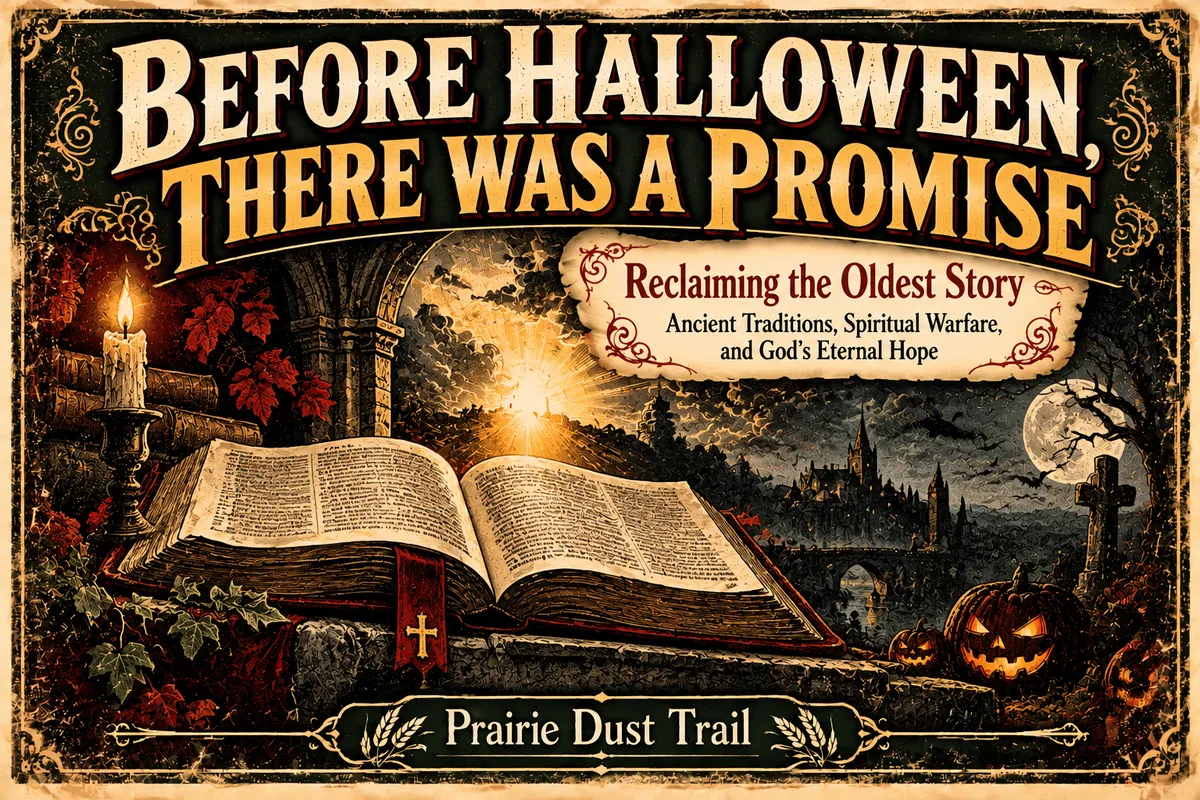
Before Halloween, There Was a Promise: Reclaiming the Oldest Story
Long before Halloween, humanity was telling stories about death, darkness, spirits, and eternal life. What does the Bible reveal about these ancient themes—and how can Christians use them to share the hope of the Gospel?
We've spent October talking about monsters, and I think we've had a rather interesting time of it.
Dr. Jekyll showed us what happens when we indulge the darkness within ourselves. Frankenstein explored the dangers of wanting a creator's power without accepting a creator's responsibility. And Dracula introduced us to a creature who takes life from others to preserve his own.
Now we've arrived at Halloween itself, and I'd like to ask a question that might surprise you.
What if the stories we associate with Halloween are much older than Halloween?
I'm not just talking about ancient Celtic festivals, medieval Christian traditions, or the modern fascination with ghosts, witches, and vampires. I'm talking about the ideas underneath them.
Death. Eternal life. Unseen spiritual beings. Fire and judgment. Good and evil. The possibility of life after death. The struggle between light and darkness. The hope that someday evil will finally be defeated.
These are themes we find throughout Scripture, in accounts and promises that, according to the Bible, reach back to humanity's earliest beginnings.
Long before plastic skeletons, jack-o'-lanterns, and children dressed as superheroes, people were asking questions about the unseen world. And long before anyone collected the biblical books into the Bible we recognize today, the people of Israel were passing down stories about God's dealings with humanity.
So perhaps the most interesting question isn't whether Christians can find something good in Halloween.
Perhaps it's this:
What if the good news we have to share is older than the darkness we're afraid of?
Before Halloween, Before Samhain, Before Wicca
Let's get a little history out of the way first, because Halloween has accumulated almost as many origin stories as it has costume options.
One important historical influence is Samhain, a Gaelic seasonal festival associated with the transition from harvest into winter. Folklore connected this season with supernatural encounters and the boundary between the ordinary world and the Otherworld.
Halloween also has a Christian history. Its name comes from All Hallows' Eve, the evening before All Saints' Day. Medieval customs surrounding the remembrance of the dead contributed to the traditions that eventually developed into modern Halloween.
The Library of Congress discusses the combination of seasonal customs, costumes, bonfires, and later American traditions in its article The Origins of Halloween Traditions.
Meanwhile, English Heritage's discussion of Halloween, All Saints' Day, and All Souls' Day is a useful reminder that the relationship between pre-Christian and Christian observances isn't as simple as one group stealing an entire holiday from another.
And here's a distinction that often gets lost: modern Wicca is not the same thing as ancient Celtic religion. Wicca developed as a modern religious movement, particularly through the work of Gerald Gardner in the twentieth century. Historian Ronald Hutton documents that development in The Triumph of the Moon: A History of Modern Pagan Witchcraft.
That doesn't mean modern Wiccans cannot draw inspiration from older traditions. It means we shouldn't casually treat a twentieth-century religious movement as an unchanged survival from thousands of years ago.
History matters.
But for this article, I want to go farther back than any of those developments. Because even the oldest documented Halloween customs are relatively recent compared with the world described in Genesis.
And the Bible presents a remarkable idea:
Humanity's knowledge of God did not begin with a holiday, a temple, a priesthood, or even a written book.
It began with God Himself.
The Bible Begins With God Speaking
Genesis doesn't open with human beings sitting around a campfire trying to invent an explanation for the universe. It begins with God creating.
God speaks, and there is light. God forms the world, fills it with life, and creates human beings in His image. He gives them responsibilities, boundaries, and a relationship with their Creator. Then comes the serpent, temptation, disobedience, shame, and the entrance of death into the human story.
And almost immediately, we encounter a promise.
In Genesis 3:15, God speaks of ongoing conflict between the serpent and the woman's offspring, including a future blow against the serpent's head.
Christians have traditionally understood this passage as the first anticipation of the Gospel, sometimes calling it the protoevangelium, or first Gospel.
The passage doesn't lay out the entire New Testament. Adam and Eve aren't handed a complete explanation of the incarnation, crucifixion, and resurrection. But within the Christian reading of Scripture, this is the beginning of a promise that unfolds throughout the biblical story.
Evil will not have the final word.
And notice when that promise appears.
Before Israel becomes a nation. Before Moses receives the Law. Before the prophets write their books. Before the New Testament. Before the Christian Church.
According to the biblical narrative, the struggle between good and evil and the hope of redemption are part of humanity's story from the beginning.
That doesn't prove that every ancient culture remembered Genesis 3:15. We don't have historical evidence for that. But it gives Christians a very different starting point when thinking about humanity's fascination with supernatural conflict.
We aren't beginning with the assumption that people invented spiritual questions and eventually stumbled upon God. We're beginning with the biblical claim that God revealed Himself first.
The Stories Came Before the Books
This is one of the details I wish more people understood about the Bible. The Bible didn't arrive in human history as a single completed volume, neatly bound and delivered to somebody's front porch.
It contains books written and collected across many centuries, preserving laws, songs, genealogies, wisdom, prophecy, historical accounts, letters, and teachings.
And ancient Israel lived in a world where oral tradition was enormously important. Stories were told. Songs were sung. Genealogies were remembered. Children were instructed. Families and communities preserved their identities by passing along what they had received.
In How the Bible Became a Book, biblical scholar William M. Schniedewind explains that early Israel's literary culture was rooted substantially in oral stories, songs, proverbs, and traditional teaching. The American Bible Society's overview of how the Bible came to us likewise describes how biblical traditions were transmitted orally before and alongside their preservation in writing.
Now, that doesn't mean every biblical passage existed for centuries as an unchanged spoken story before somebody wrote it down. The relationship between oral tradition and written Scripture is more complicated than that.
But it does mean that the story of God's dealings with humanity is older than the final collection of biblical books.
Scripture itself emphasizes this passing down of memory. In Deuteronomy 6, Israel is instructed to teach God's commandments diligently to their children, speaking of them throughout ordinary daily life. Psalm 78 describes one generation telling the next about God's mighty deeds so that future generations will place their hope in Him.
Think about that.
Before everybody had a Bible on the bookshelf—or a Bible app on their phone—families were expected to remember and retell what God had done. The stories mattered because the promises mattered. And remembering was part of remaining faithful.
Why Humans Create Rituals Around the Things They Fear
Now here's where I think things get particularly interesting.
Human beings are creatures of habit.
We like routines. We like predictability. We like knowing what comes next. And when we're frightened by something we cannot understand or control, we're often tempted to create a ritual that makes us feel safer.
We do it in surprisingly ordinary ways! We develop little routines before important events. We keep lucky or memorial objects. We repeat familiar words. We establish family traditions. We follow procedures because they give us a sense of order. Some of those habits are useful. Some are harmless. Others become superstitions when we begin believing the ritual itself can control outcomes beyond our power.
Ancient people faced dangers that modern life has made easier to forget. Winter could bring hunger. Illness could devastate a household. Childbirth was dangerous. Storms could destroy crops. Death could arrive suddenly.
It's understandable that communities developed ceremonies and traditions around harvests, changing seasons, ancestors, and the unseen world.
But there's another side to ritual that Christians should recognize.
God Himself gave His people practices of remembrance.
Consider Passover. In Exodus 12, God instructs Israel to observe a memorial of His deliverance from Egypt. The celebration is not supposed to make the people powerful enough to defeat Egypt themselves. It is meant to remind them of what God has done.
Or consider the memorial stones in Joshua 4. When future children ask what the stones mean, the people are supposed to tell them about God's mighty work.
The Lord's Supper serves a similar purpose. Jesus tells His followers to remember Him.
God knows human beings need reminders. We forget. We become distracted. We begin treating yesterday's deliverance as today's ordinary circumstance. So we tell stories, gather together, observe meaningful practices, and teach our children what those things mean.
But there's a crucial difference between remembering God's promise and trying to manipulate spiritual power.
One says, “God has been faithful, and we trust Him.” The other says, “If I perform this correctly, perhaps I can make the unseen world do what I want.”
Those two attitudes can look remarkably similar from the outside. The difference is where we place our trust.
We Have Always Been Fascinated by the Unseen World
Consider how many familiar Halloween images connect to questions the Bible addresses.
Ghosts and spirits remind us that human beings have long wondered whether death ends our existence.
The Bible contains accounts involving angels, demons, spiritual beings, and unusual encounters with the dead. In 1 Samuel 28, Saul seeks out a medium at Endor, despite God's prohibition against consulting the dead. The account is hardly an endorsement of the practice, but it shows that questions about the dead and the unseen realm were present in the ancient biblical world.
Fire can represent warmth, protection, destruction, purification, or judgment. Scripture uses fire in several of those ways, from God's appearance to Moses in the burning bush to the imagery of final judgment.
Darkness can describe literal night, danger, ignorance, or moral evil. Light can represent life, revelation, goodness, and God's presence.
The Bible also speaks of a spiritual struggle beyond ordinary human sight. In Daniel 10, a heavenly messenger describes conflict involving spiritual princes. Ephesians 6 tells Christians that their struggle is not merely against flesh and blood. Revelation uses vivid symbolic imagery to describe conflict involving the dragon, heavenly beings, and the people of God.
And then there is death itself. From Genesis through Revelation, death is a recurring concern. But so is God's promise of life. Daniel 12 speaks of resurrection. Jesus declares Himself the resurrection and the life in John 11. First Corinthians 15 celebrates Christ's victory over death.
These are not ideas Christianity borrowed from modern Halloween. They are deeply embedded in Scripture.
Of course, a Halloween ghost decoration isn't necessarily connected historically to the medium of Endor, and a bonfire isn't automatically a descendant of a biblical altar.
Shared imagery doesn't prove shared origins, but shared imagery can give us an opening for meaningful conversations.
Because whether someone is talking about ghosts, death, spirits, or the afterlife, they're often circling questions the Bible has something to say about. And Christians have an opportunity to answer those questions with more than fear.
What Happens When Stories Get Twisted?
Here's something else we know about humanity: we are spectacularly capable of getting stories wrong.
Sometimes we misunderstand something because we lack information. Sometimes details change as stories travel between communities. Sometimes we add dramatic elements because, well, people do love a good story. And sometimes we deliberately twist a story because the new version gives us something we want.
Power. Influence. Money. Control. An excuse to behave badly.
We don't even have to look back thousands of years to see that happening. We watch rumors grow, quotations lose their context, and misleading stories spread every day.
But Scripture shows that the problem is much older. In Genesis 3, the serpent begins by questioning what God has said. In Matthew 4, the devil even quotes Scripture while tempting Jesus.
That's an especially revealing detail.
Satan doesn't have to persuade someone to abandon every word of Scripture. Sometimes he can tempt them by misusing the words themselves.
A true statement can be placed in a false context. A good desire can become an excuse for disobedience. A practice intended to honor God can become an opportunity for pride, exploitation, or superstition.
The Biblical prophets repeatedly confronted people who continued performing "correct" religious rituals while neglecting justice, mercy, and faithfulness.
The problem isn't always that people have forgotten how to perform the ceremony. Sometimes they've forgotten whom the ceremony was supposed to honor. And that brings us to an important Christian understanding of evil.
Satan Is Not Another Creator
One of the things I appreciate about the biblical worldview is that Satan is never presented as God's equal. The Bible doesn't teach that the universe belongs to two equally powerful creators, one good and one evil, endlessly competing for control.
God alone is Creator.
Satan is a creature. A rebellious one, certainly. A dangerous deceiver and adversary, according to Scripture. But not a rival god with independent creative authority.
John 1:3 says that all things were made through the Word. Colossians 1:16 likewise presents all created things, visible and invisible, as existing through and for Christ. In John 8:44, Jesus describes the devil in connection with lies and murder. First Peter 5:8 describes the adversary as one seeking to devour.
That gives us a striking picture.
God creates life. The Enemy works to corrupt, deceive, divide, and destroy.
Now, Scripture doesn't explicitly say Satan is incapable of inventing a new lie, ritual, or strategy. We shouldn't turn a useful theological observation into a claim the Bible never makes.
But Satan cannot create life or goodness independently of God. He works within a creation that already belongs to the Lord. And the biblical examples of temptation frequently involve the distortion of something good.
The desire for wisdom becomes an invitation to disobey.
The desire for provision becomes a temptation to distrust God.
The desire for authority becomes a temptation to worship the wrong master.
Even Scripture itself can be quoted for an unholy purpose.
So when Christians encounter old traditions involving death, fire, spirits, protection, and supernatural power, I think we're right to ask whether good human longings have sometimes been misdirected.
A longing for eternal life can become an obsession with controlling death.
A desire for protection can become superstition.
A desire to honor the memory of our ancestors can become an attempt to communicate with the dead.
A recognition that the unseen world exists can become the pursuit of forbidden spiritual power.
And a practice meant to remember God's faithfulness can become a ritual people trust more than God Himself.
Can we prove that every ancient pagan ritual began as a corrupted biblical practice? No. But the Bible gives Christians a clear framework for understanding how good things can be distorted. And that framework is worth bringing into our conversations about holidays like Halloween.
Reclaiming the Good Doesn't Mean Pretending Everything Is Good
Now, I can already hear a few objections.
“Are you saying Christians should adopt pagan rituals and give them Christian names?”
No.
“Are you saying every Halloween tradition secretly began as a biblical celebration?”
Also no.
“Are you saying Christians should ignore the Bible's warnings about witchcraft, divination, and seeking forbidden spiritual power?”
Absolutely not.
Deuteronomy 18 speaks plainly against divination and attempts to consult the dead. Christians should take those warnings seriously. But taking evil seriously doesn't mean we must surrender every subject evil has ever touched.
Think about it.
Satan uses lies. That doesn't mean we abandon language. People use money for wicked purposes. That doesn't mean Christians must never earn or spend money. Music can glorify evil. That doesn't mean music itself belongs to evil. Fire can destroy. It can also warm a home, cook a meal, and give light. And stories about death can inspire fear, but they can also create opportunities to talk about resurrection.
The question isn't simply whether something has ever been used for evil. The question is what it means, what it does, and whether we can engage with it faithfully.
Sometimes faithfulness means refusing to participate. Sometimes it means changing a practice. Sometimes it means explaining the truth behind a symbol. And sometimes it means taking an ordinary cultural moment and using it to tell a better story.
We don't have to pretend darkness is harmless to proclaim that Christ has overcome it.
Halloween Gives Us Questions Christians Already Know How to Answer
Imagine a child asking why people are afraid of ghosts. That's an opportunity to talk about death, the unseen world, and the hope Christians have in Christ.
Imagine someone wondering why ancient people feared the coming winter. That's an opportunity to talk about human vulnerability, the importance of preparation, and trusting God through uncertain seasons.
Imagine a conversation about monsters. That's an opportunity to discuss sin, temptation, and the ways human beings sometimes become destructive.
A vampire story can lead to a conversation about life and sacrifice. A story about an evil spirit can lead to a discussion about spiritual discernment. A conversation about death can lead to the resurrection. And a glowing jack-o'-lantern on a dark porch can become a simple illustration of light shining in darkness.
Not because pumpkins are secretly biblical. They're pumpkins. But because Christians can use familiar things to communicate eternal truths.
Jesus did something similar throughout His ministry. He used seeds, sheep, bread, lamps, vineyards, coins, and ordinary family relationships to teach about the Kingdom of God.
Paul, speaking to the Athenians in Acts 17, even began with an altar dedicated to an unknown god. He didn't endorse everything the Athenians believed. He used something familiar to point toward the God they did not yet know.
What a wonderful model for us.
We don't have to agree with every tradition to recognize an opportunity for conversation. And we certainly don't have to be afraid or judgmental of every question.
Maybe We Should Spend Less Time Arguing and More Time Telling the Story
Here's where I have to be careful, because I could probably climb onto a soapbox and stay there until Thanksgiving. 😅
Christians have some very strong opinions about holidays.
Halloween. Christmas. Easter. The Sabbath. Feast days. Birthdays. You name it, and somewhere somebody is probably having an argument about whether we're allowed to celebrate it.
Some of those conversations involve important biblical convictions. I don't want to dismiss sincere concerns about worship, conscience, or obedience.
But I do wonder how often we become so occupied with arguing over a holiday's history that we forget to talk about the Savior we're supposed to be honoring.
We can spend hours debating the origins of a custom and never once tell somebody about Jesus.
We can become experts at identifying what is wrong with a celebration without helping anyone understand what is right about the Gospel.
And we can become so afraid of appearing to compromise that we forget Christians are called to be lights in a dark world.
Ephesians 6 describes the armor of God, but it doesn't tell believers to spend their lives hiding from every uncomfortable cultural conversation. It calls them to stand firm in truth, righteousness, faith, salvation, and the Word of God. First Peter 3:15 calls believers to be prepared to give an answer for their hope, with gentleness and respect. And Matthew 28 calls Christians to make disciples.
Our mission is not to win an annual argument about October 31 or any other holiday. Our mission is to make Christ known.
For one family, that may mean staying home and explaining why they choose not to participate. For another, it may mean welcoming neighbors, handing out candy and tracts, and building relationships. For someone else, it may mean hosting a gathering where children learn about courage, resurrection, and the hope of eternal life.
Those choices won't look identical, and they don't have to.
But whatever we choose, we can ask a much more productive question than “HoW dO I wiN thiS arGumeNt AnD teLL pEoPle TheY'rE wRonG?”
We can ask what I suspect Jesus asked a lot: How can I use this moment to tell the truth about the Kingdom of God?
The Promise Is Older Than the Fear
We've talked about a lot of frightening things this month. The darkness within us. The consequences of human pride. The cruelty that grows from rejection. The destructive things that consume us. The unseen spiritual world. Death itself.
But the Christian story doesn't end with any of those things.
In Genesis, God creates life. When humanity falls, God begins revealing His plan of redemption. Throughout the Old Testament, the promises are slowly laid out, and in the New Testament, those promises find their fulfillment in Jesus Christ. The One who defeats temptation. The One who gives His life rather than consuming the lives of others. The One who enters death and rises again. The One who promises that evil will not reign forever.
Revelation 21:5 records the promise: “Behold, I am making all things new.”
Not merely preserving a few good things while darkness takes everything else. Making all things new.
That's the story I want people to hear when we talk about life, death, and the unseen realm - not that every ancient custom is innocent, or alternatively that candles and pumpkins are something demonic to be afraid of - but that evil is not sovereign, death is not victorious, and God's promises have not expired.
Old Stories, Timeless Wisdom
So, as our spooky October series comes to a close, I'd like to leave you with a challenge.
This Halloween, instead of beginning with the argument or the "educating", begin with the story.
What stories are people telling? What are they afraid of? What do they hope for? What do their traditions reveal about their understanding of life, death, good, evil, and the world they cannot see? And where might those questions open a door to the Gospel?
You don't have to manufacture a biblical origin for every custom. You don't have to participate in something that violates your conscience. You don't have to pretend evil is good. And you don't have to turn every conversation into a sermon.
But you can be curious. You can be courageous. You can recognize the human longing beneath an old tradition, and you can point people toward the One who answers that longing.
Perhaps that is one of the most meaningful ways Christians can reclaim what is good: not by claiming ownership of every holiday, but by refusing to surrender the conversation about life, death, and hope.
After all, the Gospel doesn't need Halloween or any other holiday to make sense. Holiday rituals and practices simply gives us another opportunity to talk about the Gospel.
And when the costumes are packed away, the pumpkins have rotted, and the last piece of candy has mysteriously disappeared, the promise will still be there.
The Light shines in the darkness, and the darkness has not overcome it.
Happy October, friends.
Now go tell somebody the Good News!
Let's Keep the Conversation Going!
If you love exploring faith, history, biblical wisdom, and practical ways to live with purpose, come join us on Dawnita's Prairie Dust Trail Substack! We'll keep digging into old stories, rediscovering timeless truths, and finding ways to put our faith into action in everyday life.
And if you've ever struggled to talk about your beliefs, values, or convictions without feeling awkward, defensive, or afraid of being ridiculed, join Kathryn at Okie Dokie Life on Substack. As a Certified Professional Life Coach, I help people find clarity, build confidence, set healthy boundaries, and have difficult conversations with kindness and conviction.
You don't have to win every argument to stand firm in what you believe. Sometimes you just need the confidence and communication skills to have a meaningful conversation.
Both Substacks are free to follow, and we'd love to have you along for the journey!